For engineering students at more than 100 universities throughout the world, the best learning experiences are accompanied by the smell of burning rubber and the roar of racing engines. These students are participants in the annual Formula SAE (FSAE) automotive design competition sponsored by the Society of Automotive Engineers (SAE). Recognized as the national championship of college automotive engineering, the event adds super power and excitement to an outstanding educational experience.
This year, SKF helped students at New Jersey’s Rutgers University and Philadelphia’s Drexel University finish in front at the FSAE competition with donations of bearing components and technical advice.
Performance and practicality
Held at the Pontiac Silverdome May 17–21, this year’s Formula SAE competition challenged students to design and build an open-wheeled, open-cockpit Formula race car powered by a four-cycle piston engine. Restrictions were placed on the car frame and engine so the students’ knowledge, creativity and imagination were tested.
In addition to meeting safety and design regulations, the competition required that cars be designed for real-world production specifications. For the year 2000, the students were to assume that a manufacturing firm had engaged them to produce a prototype car for evaluation as a production item. The intended sales market was the non-professional weekend autocross racer, requiring that the car have very high performance in terms of acceleration, braking and handling.
Students were challenged to design a car that met these parameters, and that could be produced at a rate of 1,000 annually at a cost below $9,000, with a prototype costing not more than $30,000.
During the FSAE 2000 event, all teams were evaluated by a panel of judges on the design of the car, the oral presentation of the project and the team’s cost analysis. As always, however, the competition highlight was the on-track events where the students raced in an autocross test of speed and handling, and vied for high scores in endurance, fuel economy and acceleration.
Drexel: designing for power
Members of this year’s design team at Drexel University were determined to repeat their winning performance in the high horsepower category. In 1999, their Land Dragon VIII vehicle was the high horsepower winner in the Forced Induction Class, earning a record high of 85 horsepower to the rear wheels. “On a 550-pound car, that’s enough to scare you silly,” says team member Anthony Turchi.
For the year 2000 competition, the team built on last year’s design ideas, this year using a Honda CBR 600 F4 turbo-charged, fuel-injected engine.
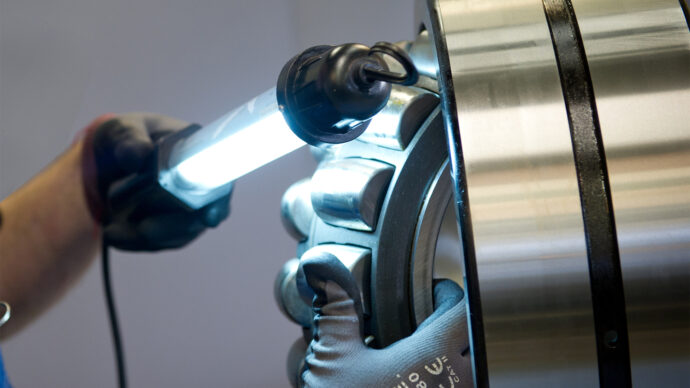
“SKF needle bearings helped us achieve our design objective,” notes Turchi. “They were used in the differential to help distribute power to the left and right rear wheels. SKF wheel bearings also helped us achieve our goals in terms of acceleration, braking and handling.”
Unfortunately, during the competition, the team’s hopes of a repeat win were dashed when a manifold pressure sensor failed, rendering the car unusable in the high horsepower competition. Despite this disappointment, the team still managed to come out a winner. From a field of more than 100 entries, Drexel’s Land Dragon placed in the top 10 in the acceleration event, 14th in the cost analysis segment and 26th in overall design. Additionally, the team’s project was selected by Drexel University to compete in the school’s senior design project competition, an honor earned by only a handful of student teams.
Rutgers: enhanced engine management
At Rutgers University, members of the Scarlet Knights Racing Team focused on improving their vehicle’s engine management system and came home winners with an award for their innovative intake system design. The team also finished 9th in the endurance portion of the competition and 19th overall.
According to team captain Christopher Strianse, the
Rutgers team’s award-winning intake system design resulted when the team was looking for a way to widen the engine power band. “We came up with a new design for the intake tubes that allows them to operate at variable lengths,” he explains. “Our idea was to create a two-piece tube system that works like a telescope. The intake tube slides in and out, changing the length in response to the engine’s RPM range. This enables power to be delivered more efficiently from low to high RPMs.”
“Bearing components donated by SKF did a great job in helping the system to function up to our design expectations,” says Strianse. SKF ball screws were mounted to the stationary and dynamic runners to enable the up and down movement of the tubes, and SKF linear bearings were specified to assure stability.
Support beyond bearings
Beyond the donation of bearing components, Drexel’s Turchi points out that SKF support in terms of advice and encouragement was valued and appreciated. “Of course we couldn’t build the car without the donation of products and materials,” he says. “But beyond that, we benefit so much from the willingness of SKF employees to offer technical advice and encouragement.”
Like many team members, Turchi hopes to pursue a career in automotive design. He points out that SKF employees attending the FSAE competition often come over and talk to team members during the event. “The recognition we receive from professionals at a big-name corporation like SKF means a lot to us,” he says.
Rutgers’ Christopher Strianse agrees that the FSAE experience and exposure to corporate sponsors can open doors to future careers. “This project takes us away from traditional textbook and classroom instruction, puts us in a real-world situation and gives us a connection to respected companies,” he says. “Those of us who have been fortunate enough to be part of the FSAE competition will have a definite edge when we enter the job market.”