
A new spin on fluids filtration
SKF bearings and application expertise enhance reliability in revolutionary fluids filtration systemRemember that ride at the county fair where you stand up along the outside wall of a large circular cage? As the ride begins to spin faster and faster, the bottom beneath your feet falls away and you are left stuck to the wall by the centrifugal force. In many industrial facilities, a miniature version of that ride is used to separate solids (also called “fines”) from process fluids.
SKF bearings and application expertise enhance reliability in revolutionary fluids filtration systemRemember that ride at the county fair where you stand up along the outside wall of a large circular cage? As the ride begins to spin faster and faster, the bottom beneath your feet falls away and you are left stuck to the wall by the centrifugal force. In many industrial facilities, a miniature version of that ride is used to separate solids (also called “fines”) from process fluids.
The system is called a centrifuge, but is more commonly referred to as a separator. The main difference between the carnival ride and the industrial separator is that the industrial version spins with enough force to actually pull solid particles out of the liquid and compress them into a separate mass which can then be disposed of or reprocessed. (Fortunately, the carnival ride provides a thrill without actual separation!)
While the concept is fairly straightforward, traditional centrifuge designs, unchanged in 15 years, have been notoriously unreliable, resulting in tremendous downtime and operator attention for maintenance and bearing replacement. Jeff Beattey, president of Midwest Engineered Products Corporation, an innovator in environmental products and fluids management services, became accustomed to seeing discarded separators as he visited customer sites. “Over and over, we saw that centrifuges designed to get fines out of grinding swarf, detactifiers out of paint booth water, fines out of coolants, phosphate baths, water and other process fluids, were broken or abandoned in the corners and bone yards of plants.”
Traditional designs: complex and unreliable
Beattey believed he had a better idea for a separator design. And, with the aid of SKF bearings and application expertise, he developed the CentraSepTM centrifuge, a separator that performs with such outstanding reliability that it is supported by a lifetime guarantee.
Centrifuges usually are installed on a side stream or kidney loop treating a specific manufacturing process. Typical designs, which are extremely complicated mechanically, include two motors, one to operate the bowl or rotor, and a second gear motor to perform the scraping for solids discharge.
The high-speed revolution of the centrifuge’s bowl, combined with the weight of the assembly and frequent out-of-balance conditions, is brutal on rotor bearings. When the bearings fail, it typically takes four to six hours to pull the rotor, just so maintenance personnel can begin to access the bearings – and that’s on automatic units. Mechanical centrifuges also require additional maintenance and service. Every time the bowl is full, the solids need to be removed manually before the next processing cycle can begin.
To avoid downtime, many processors have given up on centrifuges and have turned to paper filtration systems, sludge tanks and disposal at a higher operating cost. This is especially true with processes that require around-the-clock filtration, like grinders, paint booth water or plating operations.
CentraSep: the synchronous solution
Midwest Engineered Products’ new CentraSep centrifuge design has changed a once highly troublesome technology to one that offers trouble-free dependability.
Unlike the previous double-motor, dual-assembly designs, CentraSep uses a single motor and a unique positive locking clutch to positively synchronize the bowl and blade assembly, which consists of two scraper blades and two still vanes. The clutch couples the bowl’s main spindle and blade together so that both rotate at precisely the same speed when processing fluids. The motor is linked to the main spindle via a single chevron-style timing belt and pulley design that prevents any slippage.
“The fluid is forced to move smoothly throughout the bowl as it strikes an accelerator on entry and descends,” says Beattey. “Physically, that even, quiet flow maximizes the law of centrifugal force: any particles heavier than the liquid are thrown outward and packed against the bowl wall.” This synchronized rotation prevents blade oscillation, which can create a washout of solids from the bowl, particularly when processing superfines.
When the automatic process cycle is complete, the feed pump turns off the locking clutch, uncouples the blade assembly from the main rotor spindle and locks the blades into a fixed position. The bowl is then rotated and the dry, dense particulate that is scraped loose by the blades falls into a collection drum – ready for recycling.
The bearing challenge: speed and unbalance
A major part of the reliability problem with traditional centrifuge designs, and a challenge in developing the new CentraSep design, was the stress caused by high speeds and unbalanced loads.
According to Midwest Engineered Products Vice President Jay Beattey, “The stainless steel bowl and blade assembly weighs close to 400 pounds. To separate fluids and solids, the CentraSep needs to generate a gravitational force of over 2000Gs. Just like a washing machine, the load in a centrifuge often becomes unbalanced. When that happens the combination of speed, weight and unbalance puts a tremendous amount of stress on the bearing.”
The CentraSep design incorporates a vertical shaft rotated by an electric motor. Shaft rotation is facilitated by the inner ring of the bearing, while the outer ring must withstand the stress of the unbalanced loads.
A total solution
SKF helped Midwest meet the requirements for both shaft rotation and resistance to unbalance by providing a complete bearing solution that combined the products and application expertise necessary to provide optimal performance.
An SKF deep groove ball bearing was recommended for the CentraSep application because it is designed with a single point of contact between the bearing and raceway. This creates less friction at high speeds, enabling the bearing to perform well at speeds as high as 3000 RPM.
However, it was SKF expertise in determining the proper fit for the bearing in the bearing housing that ultimately solved the problem of failure due to unbalance.
“Choosing the right bearing was only part of the solution,” notes SKF’s national accounts manager, John Della Villa. “Meeting Midwest’s objectives in terms of reliability had more to do with proper application of the bearing for the CentraSep design. Fortunately, that kind of problem solving is an area where SKF excels.”
The solution came in fine-tuning the fit of the outer ring in the housing. “We created a very tight fit in the housing that prevents fretting and excessive wear, while allowing enough movement to accommodate the variable loads,” says Della Villa.
Because CentraSep users do not regrease the bearings, SKF also developed a custom, high-speed lubricant designed to accommodate the system’s high running speeds and to provide long-term, trouble-free operation.
A revolutionary success
CentraSep has given new life to a system that many industrial processors had once given up as junk technology. What’s more, it’s revolutionizing clarification of process fluids. The system removes even sub-micron particles (<0004”) from process fluids, offering considerably enhanced filtration compared0004 to paper filters, which cannot economically remove particles smaller than 10 to 15 microns. And, unlike conventional filtration using disposable media, CentraSep does not add volume to the waste stream. Most important, because CentraSep is fully automated and designed for long-term reliability, the downside labor, material and production costs associated with traditional systems is virtually eliminated. Enabling a cleaner environment
While helping processors eliminate 80-100 percent of their usage and costs of paper media filters, the CentraSep system’s filtration capabilities will play a critical role in helping processors meet their zero-discharge commitments. “Strategically, you capture the maximum quantity of any contamination at the point of origin,” notes Jim Beattey, Midwest’s founder. “It’s smart business that’s also good environmentally.
You improve and extend the life of the process fluids, you pack the particulate in as tightly as possible and you minimize any discharge of this captured particulate into the waste treatment stream.”
Built for a lifetime
Midwest is so confident in the reliability and performance of the CentraSep system that it offers the industry’s first – and only – lifetime warranty. As part of the warranty, Midwest technicians perform an annual change out of the rotor assembly’s mechanical parts. “In doing so, we’ve noticed that the bearing wear is well within our design criteria,” says Midwest’s production manager, Archie Spangler. “So we know that having SKF fine-tune the application was time well spent.”
CentraSep Successes
The CentraSep System
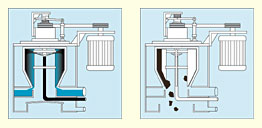
Before the process cycle, the positive locking clutch couples the blade assembly (two scraper blades and two stilling vanes) to the bowl drive. This ensures that the blade assembly rotates at the same speed as the bowl, keeping the fluid flowing smoothly. To begin the cycle, the variable frequency drive rapidly accelerates the rotor assembly to the required processing speed. Dirty fluid is then pumped through the injector tube, where an accelerator forces it into the rotating bowl. The blade assembly eliminates slip while centrifugal force extracts solids and packs them to the bowl wall. As more dirty fluid enters the bowl, clean fluid is forced out through the bowl mouth.
Scrape Cycle As the end of the process cycle, the feed pump is turned off and the variable frequency drive rapidly decelerates the bowl to a smooth stop. The positive locking clutch uncouples the blade assembly from the bowl drive and locks it into a fixed position. The bowl is then rotated while the blades scrape the bowl wall, discharging the packed particulate into a collection receptacle. When the bowl is clean, the positive locking clutch recouples the blade assembly to the bowl drive and the process cycle begins again. The entire process is automated, requiring no operator attendance. |