

Green mill makes brown paper
Vibration-monitoring technology has made the difference with Texas-based CSI’s paper-recycling operation.
Vibration-monitoring technology has made the difference with Texas-based CSI’s paper-recycling operation.
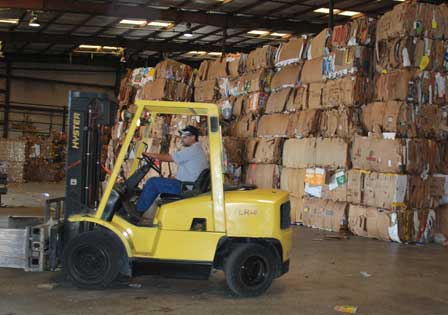
When some companies scramble to position their image as environmentally green, Corrugated Services Incorporated (CSI) in the United States is in its fourth decade of producing 100 percent recyclable brown paper from 100 percent recycled paper products.
“Recycled corrugated products are the raw mater-ial for our paper production,” says Bill Baker, vice president marketing for the Texas-based mill, “so our mill helps close the recycling loop.”
CSI supplies its paper to box makers and corrugators from the east coast to the west coast. It operates a closed water system for recyclable water. CSI was one of the first mills in the world to do this,
resulting in 85 percent less water used for paper production than a typical containerboard producer. It also generates electricity and steam from 100 percent recycled wood that is collected from used pallets.
While establishing itself as one of the most environmentally responsible mills in the world, CSI has built a profitable business.
“Our actions and investments are vetted by a strong sense of corporate responsibility,” says Baker, “but are driven by good profitable business. Each of our projects has a solid financial basis, in addition to its positive envir-onmental impact.”
CSI is a success storythe size of its home state of Texas, considering the company’s combined environmental pioneering and steady growth. As the largest consumer of recycled paper products in the state, CSI generates approximately $250 million in annual sales revenue. CSI has enjoyed revenue growth of 12 percent each year since 2000, with production volume growing comparably. The company will produce more than 300,000 tons of containerboard this year, which amounted to some 900 tons per day.
This is an impressive leap from CSI’s humble beginnings. In 1974, entrepreneur Jones Felvey started CSI with a single paper machine using 100 percent recycled paper products. Some of the machine parts at that time dated back to the 1800s. Today, led by CSI president Forest Felvey, son of Jones, the mill is sprawled across more than 160 acres at its main facility situated about 20 miles east of Dallas. The facility houses 340 employees, two paper machines, a coating plant and a small converting facility.
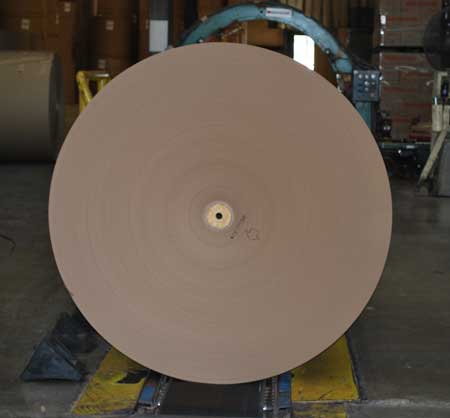
CSI produces three-ton rolls of two types of paper: linerboard and corrugating medium. Linerboard is the brown paper seen on the outside of a corrugated box. Corrugating medium is the fluted paper that forms the inner structure of the box.
“We have alwaysreinvested in our business to keep our equipment and technology up to date,” says Baker, “even in this difficult year.”
Many of the investments has gone into the paper-
recycling operation where condition monitoring technology is extending machine availability. CSI’s predictive maintenance specialists Gary Huggins and Jim Abbott work as a team while using this technology to isolate any problems that need to be addressed.
“The biggest factor is reduced unscheduled downtime and repairs,” says Abbott, “which are significant cost savings.” One hour of downtime for a paper machine costs CSI $6,000 per hour.
“Our goal is to expand the life of our paper-making equipment up to 10 years,” says Huggins. “If the equipment is well maintained, it’s possible to extend the life of a pump to 15 years.”
The key to increase the reliability of the company’s machinery is the predictive-maintenance tools: SKF MARLIN inspection system, SKF Microlog Analyzer and SKF @ptitude Analyst software.
With the Microlog, Abbott reads as many as 18 “points” on one bearing. All bearings have unique vibration behavior. Unusual or out-of-range vibration levels may signal a misalignment or bearing damage and will be reported. Some readings are ultrasonic, capable of detecting bearing damage on a microscopic level. When visually inspected, a bearing may look perfectly normal, revealing nothing out of the ordinary. However, with the appropriate equipment, for
example SKF’s Acceleration Enveloping, incipient damage can be detected.
“We monitor pumps, motors, all machine bearings, blowers, fans and gearboxes,” says Abbott. “SKF has helped us reduce unscheduled downtime and perform targeted maintenance by finding the root cause of damage so that we can prevent failures from reoccuring.”
The mill’s larger paper machine is a 700 tons per day, 176-inch machine that produces premium, finished
linerboard.
“The smaller one-out machine is the Fightin’ Lady,” says Abbott, “and provides our customers flexibility without long lead times.” It’s a 200-tons-per-day, 87-inch medium machine that produces 23- to 40-pound paper for corrugators.
While Abbott concentrateson reading the vibration levels, gearbox and oil quality reports provided by SKF Microlog Analyzer, Huggins relies on his visual and auditory senses to detect unusual sights and sounds.
“Each gearbox has a unique sound,” says Huggins, “so I use my ears or a stethoscope to listen. If something appears unusual or sounds ‘off’ then we can combine my visual inspections entered into MARLIN with the reports from Abbott’s readings to determine if a part needs attention.
An advantage of SKF @ptitude Analyst software is that trends can be monitored over long periods of time,
enabling the team to pinpoint a future date for machine and part maintenance. The trends are established by combining Microlog reports with MARLIN inspection readings. Abbott studies patterns over time and is skilled at predicting when a machine may fail, providing the team with valuable insight into parts and machinery deterioration.
Even in the midst of a down economy, CSI is well pos-itioned for the future as a versatile business progressive, in technology and protective of the environment.
“The industry has seen unprecedented downtime in 2009, due to weak demand for manufactured products and thus corrugated boxes,” says Baker. “Industry shipments are more than 10 percent below 2008 levels, and prices have fallen significantly. That said, corrugated boxes are essential to manufactured products, shipped products and anything that needs affordable product protection. The future will be tough, and many companies will not survive. But we produce an excellent product that is environmentally friendly, versatile and essential. I expect 2010 will be stronger than 2009.”
The future of CSI’s technical solutions is already focused on avoiding occurrences by getting to the root cause of the problem. The company is exploring SKF’s IMX 16 Channel Multilog Online System that is capable of sending data online directly into a database 24 hours a day.
A key to reliability
SKF’s technical solutions have contributed to annual savings of tens of thousands of dollars for Corrugated Services Incorporated (CSI), the largest consumer of recycled paper products in Texas. The company’s recycling operation has evolved into a self-contained “green” powerhouse, using 100 percent recycled paper products, operating a closed water system and generating electricity and steam.
The primary key to CSI equipment’s mechanical reliability is attributed to the predictive-maintenance tools: SKF MARLIN inspection system, SKF Microlog Analyzer and SKF @ptitude Analyst software.
MARLIN enables visual inspections and gauge readings to be entered into the hand-held device, which then uploads the data into @ptitude Analyst software.
The Microlog is used to record patterns of machine movement indicating vibration levels, misalignment, deterioration of motors, gearboxes, rolling bearings and pumps. These readings are also fed into SKF @ptitude Analysis software, which is a comprehensive solution with powerful diagnostic and analytical capabilities. It provides fast, efficient and reliable storage, analysis and retrieval of complex machine information. For instance, if the amplitude (vibration, oil, pressure) on certain parts is too high or too low, an alarm is generated in SKF @ptitude Analyst and can be easily included in a report.
Vibration level trends and alarms provide valuable information regarding damaged equipment and maintenance needed.
CSI has leveraged these condition monitoring tools by reducing unscheduled outages, thus optimizing production time. CSI’s operation efficiency derived from SKF condition monitoring technology is profound, saving the company tens of thousands of dollars annually.