

Textiles with a global spin
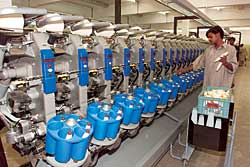
Pakistan-based Gul Ahmed Textile Mills Ltd. takes a global view of the market. Its products are found in homes, and on people, around the world.The fertile Indus Valley, which cuts right through the heart of Pakistan, has grown cotton for thousands of years. When Alexander the Great’s armies swept through in 325 B.C., the soldiers were startled to see people wearing clothes made out of what they called “wool produced in nuts.” What they were admiring was cotton cloth.
The tradition of growing cotton has remained. Cotton is still planted along the Indus River, which flows down from the melting snows of the Himalayas. It’s picked by hand and carried on the backs of donkeys. Eventually the cotton is loaded onto Pakistan’s colorful trucks (they’re often decorated with paint and poetry and garnished with sequins) and hauled to textile factories hundreds of miles away.
Much of the raw cotton ends up at Gul Ahmed Textile Mills Ltd. in Karachi, Pakistan’s bustling port on the Arabian Sea. Yarn spun at Gul Ahmed will be knit into brand-name sweaters. The colorful cotton prints designed at Gul Ahmed are destined for a global furniture chain. The bed sheets with cartoon characters and the ready-made curtains head directly for the shelves of specialty stores in Europe and the U.S.
Despite the geographical distance from its markets, Gul Ahmed has been able to keep its eyes on the global prize. With help from a generation of young, savvy business managers, the company embraces new ideas. One of the newest company directors is Jawaid Iqbal, 27. Iqbal was educated in the United States and returned home after graduation to help run the family business and to take his seat as the company’s youngest director.
Under Jawaid Iqbal, the company has pressed forward, modernizing its weaving and spinning units. In 2000, Gul Ahmed spent a record 1 billion Pakistani rupees (USD 16 million) on refurbishing its equipment. In May 2001 the company added 13 German-made compact ring spinning machines, each with 1,200 spindles. It also installed 120 new looms, each 340 centimeters wide, doubling Gul Ahmed’s air jet capacity.
To keep up with demand, Gul Ahmed’s manufacturing units thunder along 364.5 days a year. (They take a half-day off in observance of Eid, a Muslim holy day.) Millions of delicate strands of cotton, threaded onto massive steel rollers, are fed through the flying jaws of the weaving machines; 100,000 spindles roll cotton into yarn.
Computers drive much of the machinery, but more than 5,000 men working eight-hour shifts are needed to monitor and repair the equipment and keep the workspace spotless. The looms constantly spit out cotton fibers, which can jam the bearings. So in addition to an army of men wiping down the machines, vacuums ride on overhead tracks, traversing the length and width of the factory.
With an international customer base, the company does extensive quality control, both on the factory floor and in its laboratory. At every stage of production, samples are pulled off the assembly line and tested for uniformity, color fastness and shrinkage. “Each step is checked in the lab before it is sent on,” says Moazzama Khatoon, who is in charge of the company’s laboratory. “It must be caught as it happens. Because once it’s finished it’s too late.”
The lab also performs safety tests required by multinational companies, she says. For example, it conducts flammability tests on bumper pads, crib sheets and blankets. The lab even does saliva tests, Khatoon says. “We make sure that if a baby chews on something, the saliva doesn’t interact with the dyes in the sheeting.”
Gul Ahmed’s modern lab facilities and state-of-the-art equipment give the company the flexibility to respond quickly to changing market demands. Director Jawaid Iqbal regards the fickle nature of the clothing and home textile market as a challenge, not as a threat. “We were the first company in Pakistan to make Lycra,” he says. “Now it’s no longer profitable, so we got out of it. Things change, so you have to change with the times.”
The directors of the company are fully aware of the global economic turndown that is hitting the textile industry. But Jawaid Iqbal doesn’t believe the slowdown will unduly effect Gul Ahmed. Over the past 10 years, Gul Ahmed has grown at a rate of 20 percent a year. And he doesn’t expect this year to be any different.
More importantly, the quality of Gul Ahmed’s bed sheets, sofa fabric and curtains sells the products. “We are in the top tier of the market,” says Jawaid Iqbal. “If you have a good product you can always sell it.”
Martha Anne Overland
a journalist based in New Delhi
photos Zahid Hussein