
Virtual manufacturing – a growing trend in automation
Industrial automation is developing quickly, but product life cycles are getting shorter. Virtual manufacturing may relieve this strain on manufacturers.
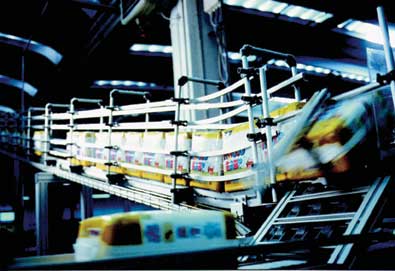
Everything we consume or buy has, at some point, come in contact with some sort of automated process. Whether it is in the factory or at the transportation stage, our mobile phones, yogurts, clothes and newspapers have all been whisked from one place to another by powerful, intelligent and, often, networked conveyor systems.
Industrial automation originates from the industrial revolution, when assembly lines were developed to manufacture products. Since then, industrial automation has progressively taken menial jobs away from humans and mechanized them. It has grown into a complex field in which computers, sensors, networks and ethernets have progressively entered to control and monitor production.
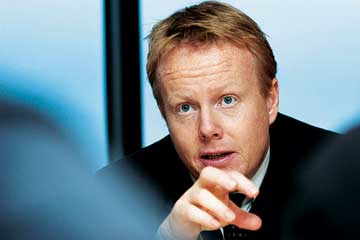
However, says Björn Langbeck, at the IVF Industrial Research and Development Corporation, a research institute in Stockholm, “it doesn’t have to be that complicated. A car is complicated under the hood, but it is easy to drive. IT systems in the factory are complicated, but they ought to be easy for the user.”
According to the Siemens Web site, in the near future it will be possible to control production at a factory by sitting in front of a Web browser. “The drivers in industrial automation are microelectronics and software,” says Klaus Wucherer, member of the corporate executive committee at Siemens AG, in an article in IEE Computing & Control Engineering magazine in July 2003.
Digital dream
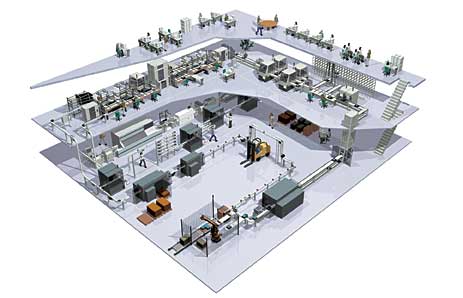
“The dream of every factory designer and automation specialist is a digital factory,” says Wucherer. “Soon, designers at an auto manufacturer will watch the virtual vehicle emerge from the virtual factory. In fact, auto manufacturers will approve a new model only after seeing the digital vehicle pass through the digital factory – and after they have exhausted all product design and production options.”
But it is the pace at which companies are churning out new products with new functionalities and tastes that has put a strain on existing factory automation. As life cycles get shorter, cost-conscious industries are slowly rethinking manufacturing routines.
In 2002, Daimler Chrysler launched a pilot project at two of its automobile factories based on this digital factory concept. The idea was to simulate at an early stage all the steps and processes that go into making a car. By doing this, the company was able to foresee problems before they happened on the factory floor, decrease time to market by 40 percent and achieve a 70 percent gain in efficiency, according the German car magazine Auto Magazin.
“More products are going to market, [and they are going] much faster than they ever have before,” says Anders Kinnander, an expert in production technology at the Chalmers Institute of Technology in Gothenburg, Sweden. “Shorter life cycles also mean that production lines have to be more flexible than ever. And this has big consequences for companies that need industrial automation for their production.”
Modular automation
Another clear trend in the field is a move toward more modular automation technologies that are easy to reconfigure, in order to satisfy particular customer needs. Approximately 70 percent of the cost of a product comes from the cost of its manufacture, and flexibility in automation can substantially cut costs.
According to Fredrik Jönsson, CEO of FlexLink, a supplier of industrial automation solutions, modular automation and virtual production (the digital factory) offer the most significant cost savings for manufacturers.
Together with IBM and others, FlexLink launched its own digital factory concept in late 2002. By combining all the aspects of manufacturing – computer-assisted design, production data management, manufacturing execution systems, supply-chain management and enterprise resource planning – into one system, FlexLink and its partners have developed one of the most flexible automation systems in the world. FlexLink calls it the PLM factory, short for “product and process life-cycle management.”
“How do you optimize future production of a prototype, quickly move to a full-scale production and maximize profits during the phase out of old products simultaneously in the same production line? … You need to manage product, production and order data effectively, and [you need to] use modular, flexible and reusable equipment and software. The key is to evaluate all options in the simulated production environment before you start in real life,” says Jönsson.
“Instead of building up production capacity dimensioned for an expected maximum volume, the idea with the PLM factory is to progressively build up capacity according to what the market needs,” he says. “If these [needs] change, the modules can easily be used for another product. In other words, we are building flexibility into the automation process, and in this fashion drastically diminishing the capital expenditures in the factory.”
Too much of a good thing?
Developments in industrial automation follow advances in IT, and, as such, are inevitable. But there is a latent worry in the business that factory procedures are getting over-engineered. In fact, there have been cases in recent history in which manufacturing plants have gone over to robotic assembly, only to realize that manual labor was much more efficient.
In fact, Chalmers’ Kinnander tells of a large truck manufacturer that decided to partially automate an axle factory in the late 1980s because of a shortage of workers. Unfortunately, axle assembly was a difficult task for the robots. The product was not designed for automatic assembly, and after seven years, the factory returned to manual assembly.